University and Industry Center Tackles Digital Twin
A new research center led by the University of Michigan and Arizona State University, with industry partners including GM and Honeywell, aims to solve

A new research center aims to solve common problems slowing the adoption of digital twins in manufacturing. The University of Michigan and Arizona State University launched the Industry-University Cooperative Research Center in March with funding from the National Science Foundation and six founding industry partners.
Digital twins are virtual models synchronized with physical equipment, such as a milling machine. These models can predict part quality and schedule maintenance, potentially reducing costs through early defect detection. However, manufacturers risk duplicating efforts if they tackle the same development challenges independently.
The National Science Foundation provides $1.5 million over five years for administrative support. Each industrial partner pays annual dues of $90,000 to fund specific research projects. The founding members are GM, Honeywell, Intel, Applied Dynamics, Applied Materials, and the U.S. Army Ground Vehicle Systems Center.
Center director Dawn Tilbury said the collaboration will enable more significant advances. "Bringing the group of members together with federal support and longer-term funding will enable us to make more significant advances and demonstrate real improvements in industrial operations," Tilbury stated.
Research Projects and Leadership
The center has defined four initial research projects. Each project involves co-principal investigators from both universities to combine expertise.
Kira Barton leads the project exploring foundation models to gain insights from historical data and machine design. Wenlong Zhang co-leads the effort to create digital twins of workers, aiming to help machines make better decisions about assisting them on the factory floor.
Testbeds for Validation
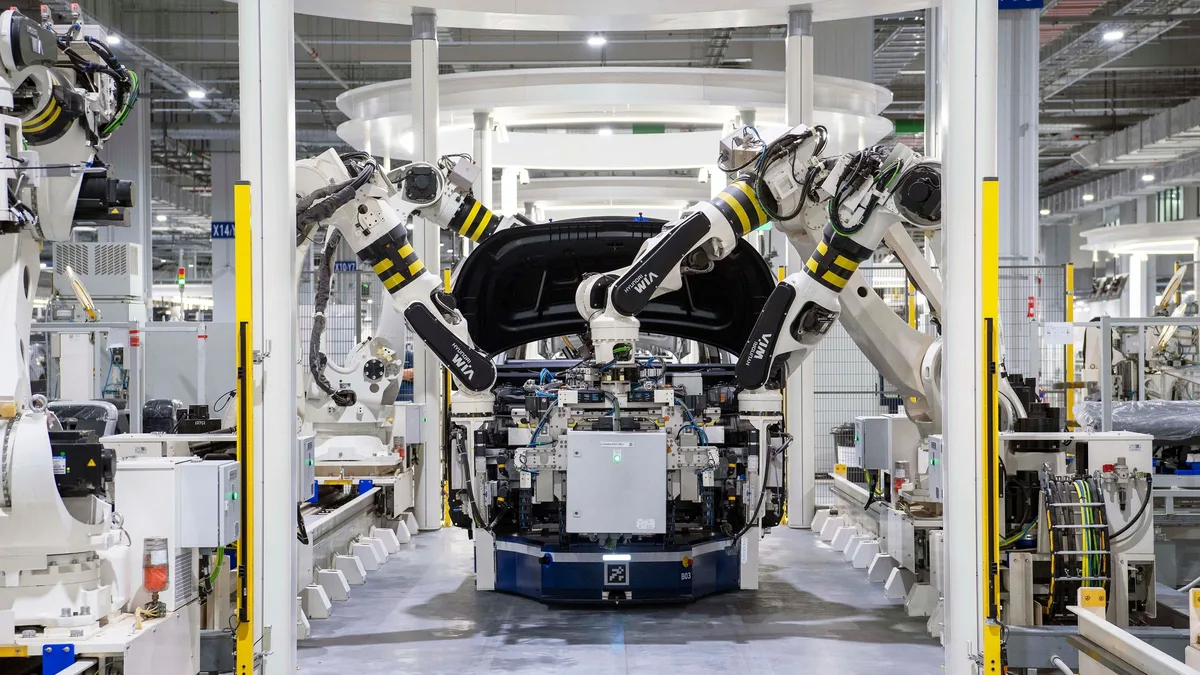
The universities will use advanced manufacturing testbeds to validate solutions. The University of Michigan offers its SMART 4.0 testbed, a connected factory featuring mobile robots, computer-controlled machines, and 3D printers linked through open process automation.
Arizona State University provides its own connected smart manufacturing system. This system includes robotics, programmable logic controllers, smart sensors, and RFID tracking for both milling and additive manufacturing processes.
Structure and Future Participation
The center operates as an Industry-University Cooperative Research Center, relying on existing university laboratories. It continues to welcome new industrial partners beyond the six founding organizations.
Dawn Tilbury also serves as the Ronald D. And Regina C. McNeil Department Chair of Robotics at the University of Michigan. Kira Barton is a professor of mechanical engineering in addition to her role as a professor of robotics.