Robot.com signs seven-year delivery robot deal with Sodexo
Robot.com has secured a seven-year commercial agreement with Sodexo Group to expand its sidewalk delivery robots on college campuses, citing labor
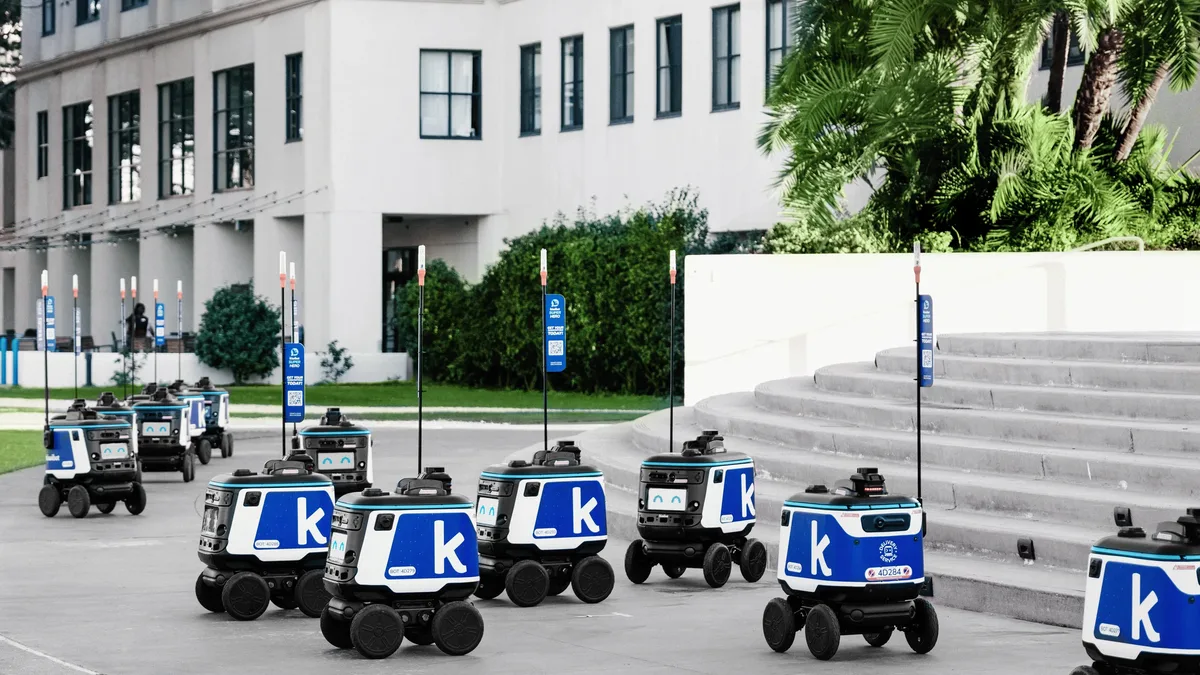
Robot.com has signed a seven-year commercial agreement with Sodexo Group, expanding a partnership that began in 2021. Felipe Chavez Cortes, the co-founder and CEO of Robot.com, told The Robot Report that Sodexo, with 120,000 full-time U.S. Employees, is a company suffering from labor shortages and unable to fill open positions.
Cortes stated that the long-term contract followed a learning process for both companies on implementing robotics. He asserted that the deal demonstrates Sodexo's leadership in bringing practical, scalable technologies to complex service environments, noting Sodexo was the first to implement food delivery robots on college campuses.
Campus deployments and the Remi platform
While some providers have pulled back from campus deliveries, Robot.com sees college grounds as a viable staging environment. Cortes explained that the economics are made viable through the company's Remi implementation platform.
"Remi is our robot implementation intelligence, and it's a product and platform that we have been developing for almost a decade," he said. This platform combines classical robotics with third-party software and advertising technology. Cortes added that implementing Remi improves the cost economics of robot deployment and increases revenue by mixing in advertising, not only delivery fees.
Expanding the robotic fleet with R-Dog
The company currently deploys its R-Kiwi sidewalk delivery robot but plans to add the R-Dog quadruped to its portfolio. Cortes said R-Dog is more versatile than the company's other delivery robots.
Unlike most systems that require recipients to retrieve items, the wheeled and legged R-Dog can drop packages. This capability could allow it to deliver a wider range of items. The mobile robot can also go upstairs or enter autonomous vehicles without vehicle modifications.
Maintenance and scaling operations
Robot.com has deployed over 500 R-Kiwi delivery robots and uses a layered approach to keep them running. Cortes described different layers of intelligence, from on-site and teleoperation attention to AI agent attention.
For safety, the company has partnered with Field AI and Physical Intelligence. Cortes acknowledged that as they deploy into more challenging environments, they are partnering with companies that have world-class researchers and engineers to support safety targets.
For scaling, Cortes is focused on one metric: operational hours generating revenue. "For this first half of the year, we already did a quarter of a million hours generating revenue," he said. The company's goal is to reach a million hours per year soon.
Foundation for future industrial use
Cortes said outdoor deliveries on campuses are preparing the company for future industrial use cases, where environments are more controlled and have normal Wi-Fi access.
"Our foundation is food delivery robots in college campuses," he continued. "But that foundation is what basically allows us to build Remi, and on top of Remi, we are introducing industrial robots."
The company is introducing humanoids, called R-noid, which feature a wheeled base and two arms. Cortes said they can sell these humanoids to the same customer base using their sidewalk robots. Some potential customers may start with delivery robots or advertising to build a business relationship before adopting humanoids.
Cortes also noted that while legs may make sense down the road, a wheeled platform currently provides the performance, reliability, and economics that work for customers. The decision between wheels and legs is related to ensuring deployed humanoids will be affordable, measured against the cost of generating revenue.