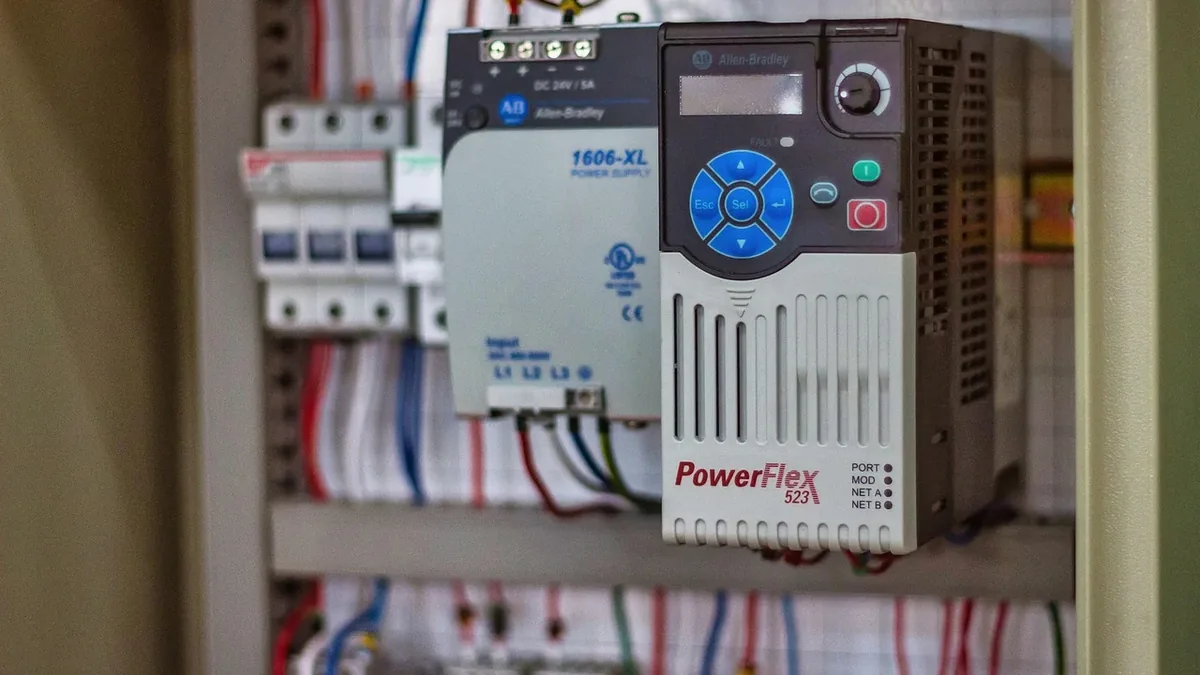
Plcs And Controls
| Process type | Industrial automation and control |
|---|---|
| Original use | To automate and control machinery and processes in manufacturing |
| Core components | Programmable Logic Controllers (PLCs), input/output modules, human-machine interfaces (HMIs), control software |
| Typical scale | Single machine to entire production line |
| Primary function | Sequence control, motion control, process control, data acquisition |
| Common industries | Automotive, food and beverage, pharmaceuticals, packaging, material handling |
Origin and history
Programmable Logic Controllers (PLCs) originated in the United States during the late 1960s as a direct replacement for hard-wired relay control systems. The automotive industry, specifically General Motors, is widely credited with issuing the initial specifications for a modular, solid-state controller to simplify machine retooling. Early PLCs were developed by companies like Modicon (founded 1968) and Allen-Bradley, utilizing ladder logic programming to maintain familiarity for electricians and plant engineers. These first devices were large, expensive, and had very limited memory and input/output capabilities compared to modern units. The technology evolved rapidly through the 1970s and 1980s with the integration of microprocessors, which enabled more complex arithmetic, data handling, and communication functions. The development of international standards for programming languages, notably IEC 61131-3 in the early 1990s, helped solidify the PLC's role as the dominant industrial control hardware.
What it is for
PLC and control systems are engineered to automate repetitive, sequential, or logic-based industrial machine and process operations with extreme reliability. Their primary function is to monitor inputs from sensors and devices, execute a stored control program, and trigger outputs to actuators like motors, valves, and lights. They are deployed to manage discrete manufacturing tasks such as assembly line sequencing, packaging, and robotic cell coordination. In process industries, they regulate continuous variables like temperature, pressure, and flow rates within systems for chemical production or water treatment. A core purpose is to enhance operational safety by implementing hard-wired emergency stop circuits and software interlocks to prevent hazardous machine states. Furthermore, these systems collect operational data for supervisory control and data acquisition (SCADA) systems, providing the foundational information for plant-wide monitoring and management.
Overview
A typical PLC-based control system is a modular hardware architecture centered on a central processing unit (CPU) that executes the control program cyclically. The system physically consists of a power supply, the CPU module, and various input/output (I/O) modules that interface with field devices, all mounted on a standardized rack or backplane. The control program is written on a separate programming device (usually a computer with specialized software) and then downloaded to the CPU's non-volatile memory. During operation, the CPU continuously runs a scan cycle: reading the physical state of all inputs, solving the logic of the user program, and then updating the state of all outputs accordingly. Modern systems incorporate advanced communication protocols like Ethernet/IP, Profinet, and Modbus TCP/IP to network multiple PLCs and connect to human-machine interfaces (HMIs) and enterprise systems. This setup creates a deterministic, real-time control layer that is electrically rugged and isolated from the often harsh factory floor environment.
What to know
The programming of PLCs is most commonly done using ladder logic, a graphical language resembling electrical relay diagrams, though other IEC 61131-3 languages like Function Block Diagram and Structured Text are also standard. A critical operational concept is the scan time, which is the total time the CPU takes to complete one read-solve-write cycle; this must be fast enough for the controlled process to ensure stability and precision. Input/output modules are available in digital (on/off) and analog (continuous range) forms, and they provide essential electrical isolation to protect the sensitive CPU from voltage spikes and noise. Redundancy configurations, involving duplicate CPUs, power supplies, and networks, are employed in critical processes where unscheduled downtime is unacceptable. Understanding the distinction between a PLC (for local machine control) and a Distributed Control System (DCS), which is optimized for large, complex process plants, is important for selecting the correct technology. Finally, cybersecurity has become a paramount concern, as networked industrial control systems are potential targets, necessitating practices like network segmentation and regular firmware updates.
Common questions
What is the difference between a PLC and a regular computer? Unlike a general-purpose computer running a multi-tasking operating system, a PLC uses a simple, dedicated real-time operating system or firmware to execute its control program in a deterministic, repetitive scan cycle with high reliability in industrial environments. How long do PLC systems typically last? Hardware lifecycles are often 10-20 years, but the control program and configuration can last for decades, with careful maintenance and occasional hardware refreshes. Can a PLC connect to databases and enterprise software? Yes, modern PLCs support open communication protocols and can exchange data with higher-level systems for production tracking, maintenance scheduling, and overall equipment effectiveness (OEE) calculations. Is programming a PLC difficult? For personnel with an electrical or instrumentation background, learning ladder logic is generally straightforward, but mastering larger, structured projects and other languages requires significant training and experience. What happens when a PLC loses power? The CPU has a battery-backed or non-volatile memory that retains the program and critical data, and upon power-up, it will resume its control cycle automatically, often from a safe pre-defined state. How are control system upgrades managed? Upgrades are major projects involving careful migration of the existing program, validation of new hardware, and extensive testing during planned shutdowns to avoid production disruption.
Pros and cons
The primary advantage of a PLC system is its exceptional reliability and robustness in harsh industrial environments, with hardware designed to withstand temperature extremes, vibration, and electrical noise. It offers tremendous flexibility, as the control logic is software-based, allowing for changes and optimizations without rewiring physical relays, which reduces downtime during retooling. The deterministic scan cycle provides predictable and repeatable timing for machine control, which is critical for synchronization and safety interlocks. A significant con is the high initial investment, not only for the hardware but also for engineering design, software licensing, and comprehensive system integration and testing. A common mistake is underestimating the long-term costs of maintenance, including the need for specialist programming skills and the risk of obsolescence for proprietary components. Companies sometimes regret a choice when they select a platform that locks them into a single vendor's ecosystem, leading to inflated costs for spare parts and future expansion, or when they fail to adequately document the control program, creating critical knowledge loss.
Who it suits
PLC and control systems are essential for any manufacturing or industrial operation involving repetitive machine automation, sequential processes, or the need for reliable safety monitoring. They are particularly suited to discrete manufacturing industries such as automotive, packaging, and material handling, where precise timing and sequence control are paramount. Process industries like food and beverage, pharmaceuticals, and water treatment also rely on them for batch control and regulatory compliance data logging. This technology suits organizations with in-house electrical and instrumentation technicians who can perform troubleshooting and minor programming modifications. It is a necessary investment for factories aiming to improve product consistency, increase production throughput, and gather detailed machine performance data for analytics. Small workshops with simple, standalone machines may find traditional relay panels or micro-PLCs more appropriate, while extremely large, complex continuous process plants might evaluate a full Distributed Control System (DCS) instead.