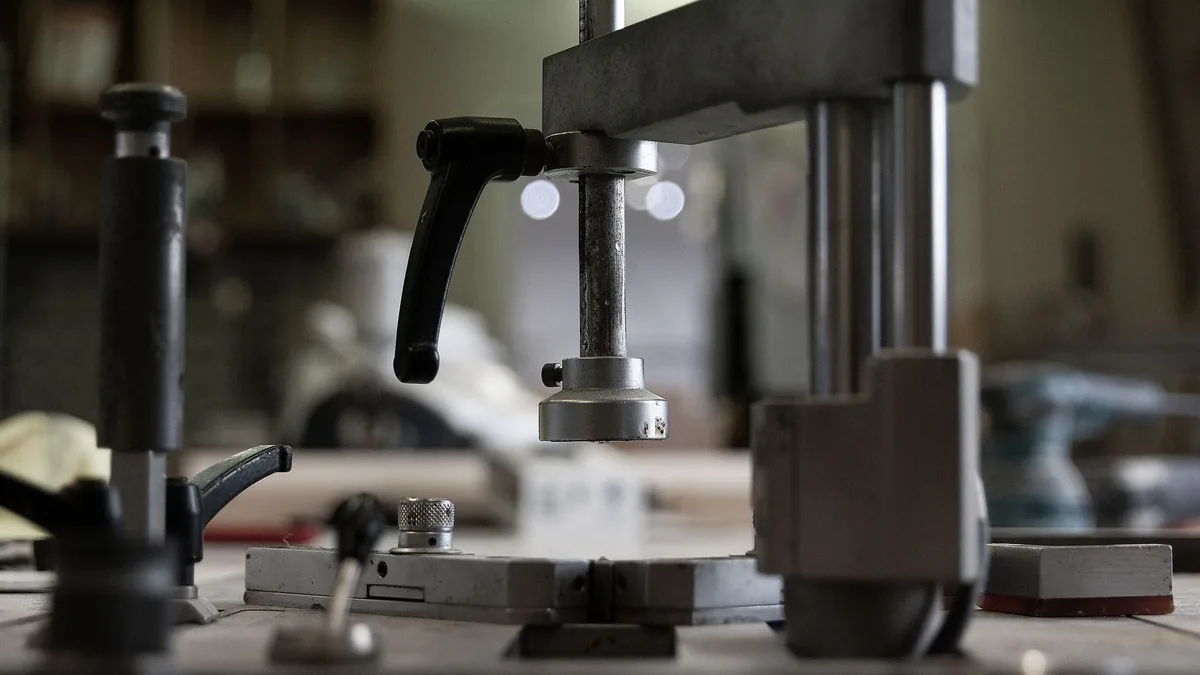
Metal Forming
| Process type | Bulk deformation and sheet forming |
|---|---|
| Primary materials | Metals (e.g., steel, aluminum, alloys) |
| Typical equipment | Presses, hammers, rolls, dies |
| Industrial sectors | Automotive, aerospace, construction, appliance manufacturing |
| Energy intensity | High |
| Common secondary processes | Heat treatment, machining, surface finishing |
| Original use | Shaping metal tools and weapons |
Origin and history
Metal forming as a deliberate craft originates from the ancient Near East, with evidence of hammered metalwork dating to the Copper and Bronze Ages, several millennia BCE. The process evolved significantly during the Iron Age, where blacksmithing became a widespread and essential technology across multiple civilizations. The Industrial Revolution of the 18th and 19th centuries marked a fundamental shift from manual, artisanal forming to mechanized processes using powered equipment. The development of rolling mills for sheet metal and the invention of the mechanical press during this era established the foundation for modern high-volume production. The 20th century introduced advanced techniques like explosive forming and superplastic forming, driven by aerospace and defense industries. Today, metal forming is a globally practiced discipline, continuously refined with computer-controlled automation and new material science.
What it is for
Metal forming is primarily used to shape metal into usable components without removing material, making it efficient for mass production. It is essential for creating structural parts with complex geometries and high strength-to-weight ratios, such as automotive body panels, aircraft fuselage sections, and appliance housings. The process is fundamental in producing standardized profiles like I-beams, channels, and railroad rails through rolling. It is also employed for making everyday items like aluminum cans, cutlery, and plumbing fixtures through drawing and stamping operations. In heavy industry, forging is used to create high-integrity parts like crankshafts, turbine blades, and connecting rods that must withstand extreme forces. Furthermore, specialized forming methods are critical for prototyping and manufacturing parts where material conservation and directional grain flow are paramount.
Overview
Metal forming encompasses a broad set of manufacturing processes where applied force causes plastic deformation of a metal workpiece, permanently altering its shape. The fundamental principle relies on the metal's ability to flow plastically under stress beyond its yield point but below its fracture point. These processes are broadly categorized by the type of stress applied: compressive (forging, rolling), tensile (drawing), combined (deep drawing), or bending. Key variables include the workpiece material's ductility and strain hardening behavior, the temperature (cold, warm, or hot forming), the strain rate, and the friction between the workpiece and the tools. The process requires dedicated tooling, such as dies, molds, and rolls, which are designed to impart the specific final shape. Successful forming operations must carefully balance these factors to avoid defects like tearing, wrinkling, or excessive springback.
What to know
Tooling design and manufacturing represent a major upfront investment and lead time, often exceeding the cost of the forming machinery itself. The choice between cold, warm, and hot forming is critical; cold forming increases strength but requires higher forces, while hot forming reduces force but can affect surface finish and dimensional precision. Lubrication is not optional but a process-critical element to control friction, heat, and tool wear, and its selection depends on the material and forming method. Springback, the elastic recovery of the metal after forming, must be accurately predicted and compensated for in the tool design, especially in bending and stamping. Material properties are not uniform; the directionality of the metal's grain structure (anisotropy) introduced during initial production affects formability and must be considered when blanking parts from sheet stock. Post-forming operations, such as trimming, piercing, heat treatment, and surface finishing, are almost always required to produce a finished part.
Common questions
What is the difference between forging and casting? Forging deforms solid metal, improving its grain structure and mechanical properties, while casting involves pouring molten metal into a mold, which can introduce porosity. How does metal forming differ from machining? Forming reshapes metal without cutting it away, preserving material and often improving strength, whereas machining removes material to achieve shape and tolerances. What metals are most commonly formed? Low-carbon steels, aluminum alloys, copper, brass, and stainless steels are prevalent due to their favorable ductility and strength combinations. What are progressive dies? These are stamping dies that perform multiple forming and cutting operations at different stations as the sheet metal strip feeds through, producing a complete part with each press stroke. What is 'necking' and 'earing'? Necking is a localized thinning that precedes failure in tensile forming, while earing is the wavy edge formed on a drawn cup due to anisotropic material properties. Why are some parts heat-treated after forming? To relieve internal stresses induced during cold working or to achieve final desired mechanical properties like increased hardness or toughness.
Pros and cons
The primary advantage is material efficiency and speed for high-volume production, as forming processes generate little to no scrap chip waste and can have very high cycle rates. Formed parts often exhibit superior mechanical properties compared to cast or machined counterparts, as the plastic deformation can refine the grain structure and align it favorably for strength. A significant con is the exceptionally high initial cost and long lead time for designing and manufacturing precision dies and molds, which makes small production runs economically unviable. The process is also somewhat inflexible; a change in part design, even a minor one, typically requires costly and time-consuming new tooling. Common mistakes include underestimating springback, leading to out-of-tolerance parts, and selecting an inappropriate lubricant or forming temperature, which can cause surface defects or tool seizure. Operations often regret choosing complex forming for prototypes or low-volume jobs due to the disproportionate tooling investment, and they may face costly production halts if a critical die fails and requires repair or replacement.
Who it suits
Metal forming suits large-scale manufacturing industries with stable, high-volume part designs, such as automotive, aerospace, and appliance manufacturers. It is ideal for companies that prioritize production speed, material yield, and enhanced mechanical properties in their components over initial tooling costs. The process is well-suited to applications where part integrity is critical, such as in load-bearing structural elements, engine components, and safety-critical hardware. It is less suitable for job shops, prototyping facilities, or industries where part designs change frequently, as the capital commitment to tooling is prohibitive. Manufacturers with in-house expertise in metallurgy, tool and die maintenance, and press operation are best positioned to implement and benefit from these processes. Ultimately, it is a strategic choice for enterprises whose business model is built on the long-term, mass production of standardized metal components.
Latest Metal Forming news
Latest reporting
Reality Show Cast in Steel Aims to Attract Next Generation of Metal Casters
A Department of Defense contract has brought a metal casting competition to the worldwide stage, aiming to spread awareness of the skill trade and...
Century Aluminum's Oklahoma Smelter Project Advances Amid Local Pushback
Century Aluminum's Oklahoma smelter project is on track to break ground this year and begin producing hot metal by the end of 2029, despite local...