Dream Labs secures $90M to universalize robot intelligence
Dream Labs raised $90 million in seed funding to launch Dream API, enabling robots to perform new tasks instantly through AI, addressing the long-standing challenge of robot programming.
Dream Labs has secured $90 million in seed funding to accelerate the development of a universal AI model for robots. The funding round, announced on October 19, 2026, was led by B Capital with participation from Kindred Ventures, A.Capital, Unusual Ventures, SV Angel, Wing VC, Scribble VC, and Adrian Aoun. The company, founded in 2026 by former NVIDIA GR00T robotics research leaders, plans to use most of the capital for computing infrastructure expansion.
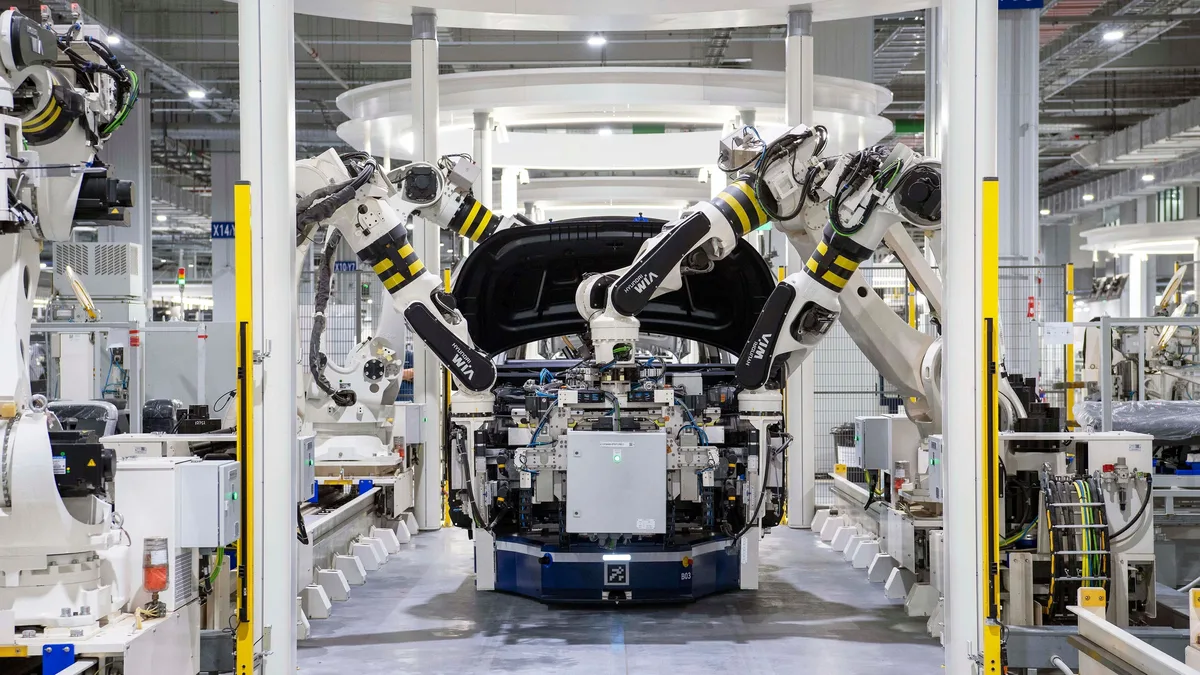
Factories worldwide now operate a record 5 million industrial robots, most of which are single-task and cannot transfer learning to other machines. Teaching one robot one task can take specialists months, and new tasks or hardware require starting from zero. Low-cost robots sell for a few thousand dollars but lack built-in intelligence. Dream Labs aims to create flexible robots using a common AI model to address this bottleneck.
Dream-1 enables zero-shot learning across robot hardware
The Dream-1 model allows robots to perform new tasks without reprogramming by learning from human video demonstrations. It is a World Action Model that predicts video and actions together. Dream-1 handles tabletop tasks like picking, placing, and folding laundry, and supports wheeled mobile robots and dexterous hands. The flagship model works across robots from different manufacturers, trained on video of people performing everyday tasks.
Dream-1 controls any robot with grippers out of the box using zero-shot learning. It predicts end-effector poses, which are translated into robot movements via inverse-kinematics solvers. The model uses three camera views: one of the scene and one on each wrist. This enables a common interface across different robots without requiring identical hardware. The company's current zero-shot capability is limited to bimanual robots with parallel grippers, with a focus on two-arm, parallel-gripper systems.
API and Robot Playground provide developer access
Dream Labs launched Dream API, the first public API for a robot foundation model. It converts camera feeds and natural language instructions into robot motor commands. Developers can sign up, connect any grippers-equipped robots, and have robots execute tasks using prompts. The API includes a fine-tuning service and a browser-based Robot Playground.
Fine-tuning as a Service lets developers submit demonstration data to receive tailored models within hours for unsupported hardware or new capabilities. Dream Labs runs its models in global data centers for fast robot responses. The Robot Playground lets anyone use a browser to command a robot in Dream Labs' San Francisco office and watch live, unedited responses without purchasing a robot.
Dream Labs supports robots costing $2,000 to $10,000, with Dream-1 requiring no extra data for two-armed robots with parallel grippers. The company has more than 20 hardware partners. Inference costs are separate from hardware and integration.
| Model Variant | Inference Cost per Hour | Action Chunk Returned |
|---|---|---|
| Dream-1 | $3 | 1.6 seconds of actions |
| Dream-1-flash | $2 | 1.6 seconds of actions |
Funding targets compute expansion for broader robot support
The $90 million will primarily fund compute infrastructure to increase the range of tasks and robots Dream-1 can handle. This expansion is critical for supporting broader robot types and more complex tasks. Dream Labs tested 27 unseen robot embodiments in simulation with 300 rollouts per embodiment. Performance varied substantially across hardware, making cross-robot transfer claims more useful when viewed with detailed results.
Broader support for mobile robots and dexterous hardware remains part of the development effort. The technology aims to reduce the number of systems firms need to develop for different robots. Daisy Cai of B Capital noted that falling hardware costs create opportunities for robotics intelligence, stating that a capable robot arm now costs like a high-end laptop, needing only intelligence.
Technical limitations remain in real-world deployment
Cross-robot capability transfer is promising but still requires validation across diverse hardware and environments. Most industrial robots are limited to few tasks in specific settings. The approach remains to be tested in real-world conditions. Transferring a policy to a different robot does not guarantee reliable completion of every task.
The control interface introduces tradeoffs. Predicting a gripper's destination does not fully determine the arm's path. Obstacles, joint limits, and inverse-kinematics solver quality can affect performance. Robots with very different workspaces or dynamics can expose further gaps between model predictions and hardware capabilities. Dream-1 is a research beta and has not been validated for safety-critical use.
Ryan Chan of MakerMods reported their robot was up and running in minutes with Dream-1, enabling unprogrammed tasks. Joel Jang, co-founder and CEO of Dream Labs, stated that the hardware is ready but a universal brain for robots has been missing. The potential for Dream-1 to reduce the number of systems firms need to develop for different robots through universal intelligence marks a significant shift in manufacturing automation.