Gravis Robotics Secures $200M Investment for Autonomous Construction
Gravis Robotics, a Zurich-based company, has announced a $200 million investment from SoftBank for its Series A round, marking the largest in construction robotics history.
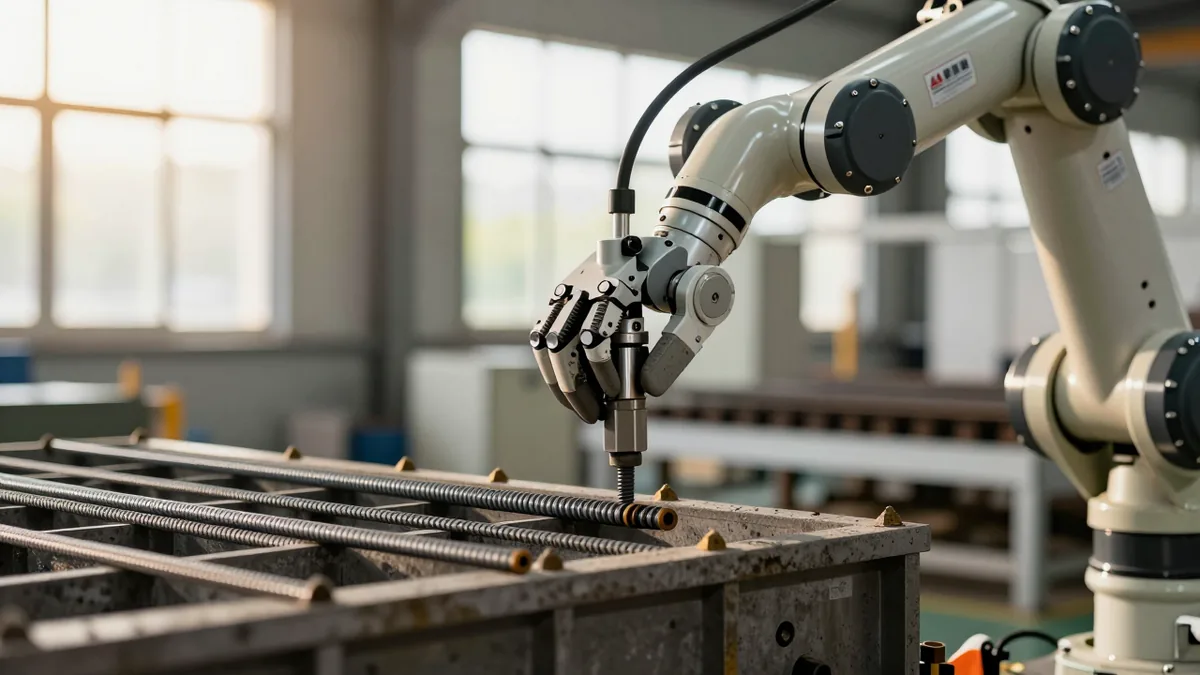
The construction industry has been slow to adopt automation, but growing demand for infrastructure repairs, AI data center buildouts, and U.S. reshoring and defense needs could change that. Gravis Robotics, a company spun out of ETH Zurich in 2022, has announced a significant investment that could accelerate the adoption of autonomous construction.
Gravis Robotics has developed physical AI for earthmoving, which operates in dynamic environments unlike traditional self-driving cars. The company's software-defined intelligence is designed to bring factory-floor precision to historically unpredictable civil jobsites. Its synthetic training enables it to move billions of cubic yards of virtual material and respond to varying subterranean forces and soil mechanics at microsecond speeds.
The company's AI takes physical input from skilled operators and grounds it in machine telemetry, responding to soil mechanics at microsecond speeds. Gravis Robotics claims that its AI has the physical intuition to handle real jobsites with precision that goes beyond what any human can feel from inside the cab.
Gravis Robotics has also developed construction autonomy designed for mixed fleets. The company's AI world model incorporates the performance characteristics of a range of manufacturers' products rather than imitating an individual operator. The model is generalizable and adaptable in a way single-machine systems can't match.
The Gravis Rack acts as an operating system for mixed fleets, installed on machinery from Caterpillar, Case, Develon, John Deere, JCB, Hitachi, Sumitomo, Yanmar, Volvo, and more. The company claims that its learning-based models excel in adapting to the nuances of machines, allowing the same core software to drive a compact excavator or a machine five times its size without custom reprogramming.
Gravis Robotics' understanding of individual machines and how they interact with the ground allows it to improve productivity by up to 30% compared with peak manual operations. The company's Slate interface can also improve worksite safety. Gravis built its software stack to offer operational flexibility with a spectrum between AI-augmented manual control and full autonomy.
The company's Series A funding will help it deploy autonomous heavy machinery across jobsites globally. SoftBank's managing director, Dai Sakata, stated that physical AI is central to SoftBank's vision for the next phase of AI, and Gravis is bringing AI-powered autonomy to construction.
Gravis has already deployed its systems across four continents and proven them across diverse real-world machinery and sites. The company has embedded autonomy into heavy machinery fleets across a trillion-dollar market bottlenecked by labor shortages. Gravis was recently chosen to lead an $8 million U.K. government-backed CAM Pathfinder project with Flannery Plant Hire, the country's largest equipment rental provider.
| **Manufacturer** | **Number of Models** | | --- | --- | | Caterpillar | 1 | | Case | 1 | | Develon | 1 | | John Deere | 1 | | JCB | 1 | | Hitachi | 1 | | Sumitomo | 1 | | Yanmar | 1 | | Volvo | 1 | | Other | 5 |
Note: The table represents the number of models from various manufacturers that Gravis Robotics has installed its Gravis Rack on.