OnRobot: Gripper needs for physical AI
OnRobot's Thomas Houden outlines four critical requirements for end-of-arm tooling to enable physical AI in manufacturing, emphasizing adaptability
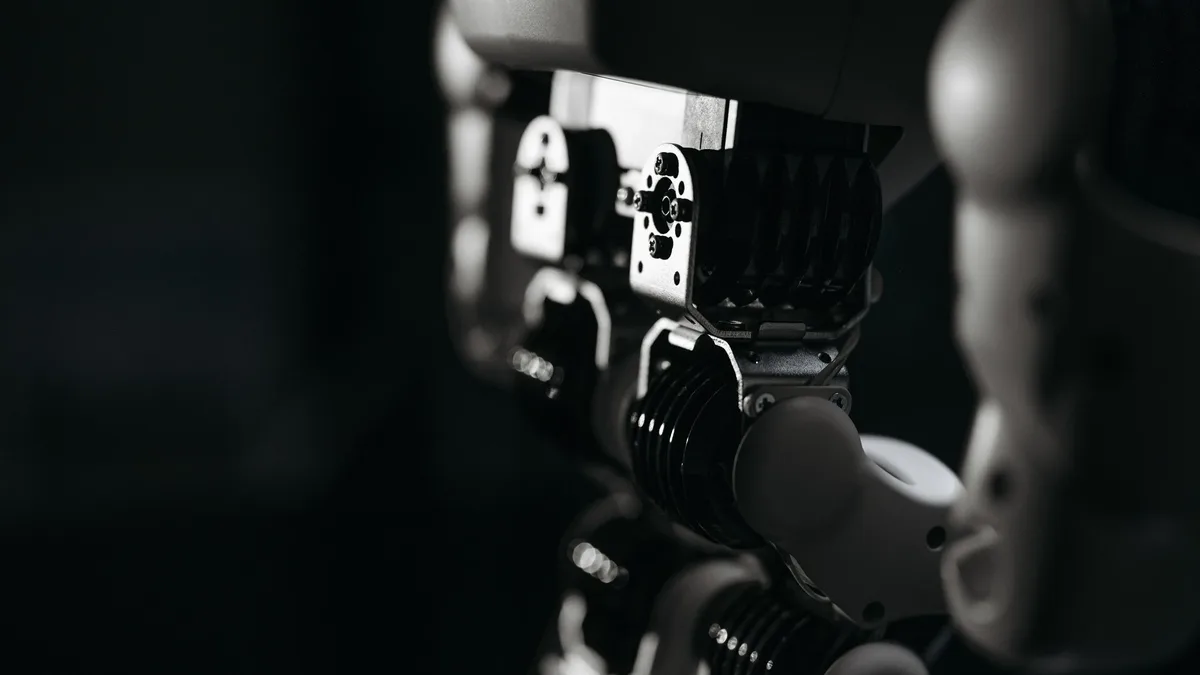
Thomas Houden, Director of Global Business Development at OnRobot, argues that advanced physical AI systems require a new generation of end-of-arm tooling (EOAT). For AI-powered robots to perceive, act, and adapt in real-world environments like factories, their grippers, sensors, and tools must form a reliable physical interaction layer. This is key for robots to operate effectively in less structured environments, as seen in our analysis of manufacturing stats.
According to Houden, physical AI promises robots that can handle real-world variability with less task-specific engineering. As AI models and robot learning advance, the execution layer grows in importance. A gripper's ability to accommodate variations in part sizes, shapes, and materials is critical. If the EOAT fails here, the model's intelligence has limited practical value. Grippers with adjustable parameters give the system greater freedom to apply its intelligence.
More capable models need reliable execution
AI models can generate actions, but hardware must execute them. Robot motion is relatively mature compared to real-world manipulation. Manipulation depends on physical variables that cannot be eliminated or perfectly modeled. This makes basic execution feedback from the gripper essential. Grip and part detection can confirm if an object is present and if a grasp succeeded, giving the system a direct signal that its intended action occurred. Flexible, feedback-capable tools expand a robot's practical capabilities, directly impacting its performance on the fixtures line.
Contact-rich data complements simulation and vision
Simulation and vision are important but insufficient for reliable manipulation. Simulation allows for quick training and testing. Vision helps with recognition and planning. Neither fully captures the physical interaction. Reliable manipulation requires physical feedback on force, friction, slip, and deformation. A grasp that works in simulation may fail in the real world. A camera can locate an object but may miss subtle slip or asymmetric contact during interaction.
Multimodal feedback from EOAT is therefore vital. Different sensing provides information at different stages:
For learning-based systems, receiving this interaction data can vastly improve training and failure analysis.
Flexibility across the tooling layer
Physical AI is associated with general-purpose robots, but a single end-effector cannot perform every task. Different objects and applications require different modes of interaction. Houden lists several EOAT types and their uses.
| Tool Type | Primary Use Case |
|---|---|
| 2-finger grippers | Broad range of handling tasks |
| 3-finger grippers | Auto-centering gripping for cylindrical parts |
| Vacuum & magnetic tools | Alternative gripping for suitable surfaces/materials |
| Force/torque sensors | Feedback for contact-rich tasks |
| Tool changers | Switching between end effectors |
In practice, physical AI requires hardware flexibility alongside software flexibility. A broad EOAT portfolio with a unified interface can accommodate different interaction modes and make tool switching easier for the robot.
Houden states that the next phase of physical AI will depend on stronger models, better data, and improved simulation. It will also depend on the physical interaction layer-grippers, sensors, and tool changers-that enable models to act reliably outside labs and fixed structures. End-of-arm tools are now an integral part of advanced learning systems, not just the last component added to a robot.