Koma Precision Explains U-Axis Heads for Milling Machines
Koma Precision details how U-axis heads enable CNC milling machines to perform turning and boring, allowing shops to complete parts in a single setup at a
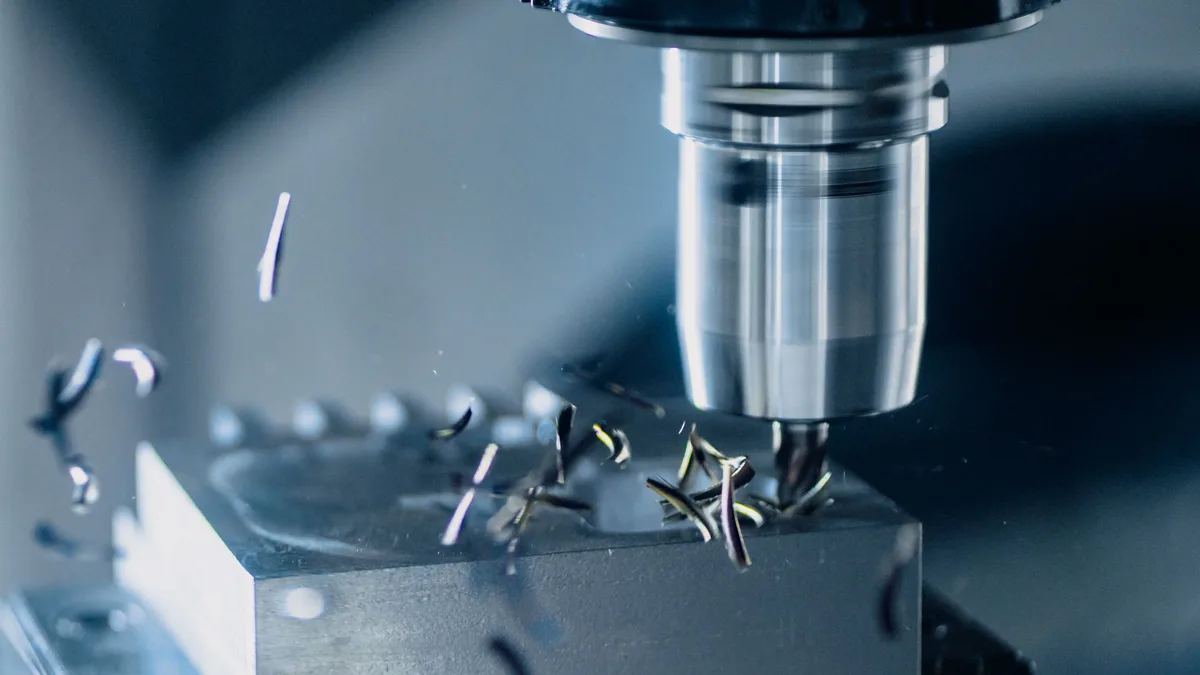
A U-axis head can enable a vertical or horizontal machining center to perform turning and boring operations, potentially machining parts complete on a single machine. This approach offers an alternative to purchasing a separate vertical turning lathe or large turn-mill, according to Jesse Meade, technical product manager for Koma Precision.
Koma Precision, which recently became the official U.S. and Mexico distributor for Italy's D'Andrea S.p.A., fields numerous questions about this technology. The company's insights, shared with Production Machining, outline the benefits, applications, and considerations for shops exploring U-axis heads.
Potential Benefits and Available Types
Combining milling and turning in a single setup reduces part handling and re-fixturing. This is particularly beneficial for large workpieces. Shops can add turning capability to existing milling machines or specify a U-axis head on a new machine purchase. Meade notes this represents a small fraction of the cost of a separate vertical turning lathe and its associated large footprint, potentially increasing a shop's competitiveness.
U-axis heads come in manual and NC-programmable versions. Manual heads are preset to a fixed diameter for cylindrical shapes, requiring manual adjustment to change the bore size. NC-programmable heads feature a servo-controlled slide, allowing the machining diameter to be dynamically changed during an operation to create contoured features like tapers.
Small heads can be kept in an automatic tool changer pocket and swapped like a standard tool. Larger units are fixed, flange-mounted installations. Koma Precision's service team typically installs NC-programmable heads on site.
| Model / Type | Taper Examples | Max Working Diameter | Notes |
|---|---|---|---|
| TA-Center 2 (110 version) | CAT 40, HSK 63 | 250 mm | Uses conventionally sized tapers |
| TA-Center 2 (170 version) | CAT 50, HSK 100 | 460 mm | For larger diameters |
| TA-Center 2 (80 version) | BT 30 | Not specified | For small drill/tap machines |
| U-Tronic (flange-mounted) | N/A | 400 mm to 4 meters | Fixed, non-ATC installation |
Key Applications and Industry Use
Major opportunities exist in the oil and gas industry for machining features like tapered bores in valve components. Several major U.S. valve companies use D'Andrea heads for this purpose. In automotive, applications include boring piston cylinders in engine blocks. A single programmable head can replace multiple custom boring bars needed for various bore sizes.
Hydraulic fittings are another significant application. Meade cites customers using rotary tables to index workpieces for drilling, then loading a U-axis head to produce precision hole tapers for ferrules. Medical applications also benefit. One customer machining hip stems achieved an average tolerance of 4 microns on a 10-year-old VMC after adding a U-axis head, surpassing the required 20-micron tolerance they struggled to meet on a multitasking lathe.
When a U-Axis Head May Not Fit
Parts consisting primarily of turned features with little milling are likely better suited to a live-tool lathe. Desired cycle times are another critical factor. "Large U-axis heads have a good bit of torque to enable heavy cutting of a variety of materials, but might top out at 500 rpm," the source explains. If high speed and throughput are paramount, a vertical turning lathe might be more appropriate.
While smaller heads like the TA-Center 2 can turn tough alloys like Inconel, care is required. A lathe might handle more aggressive cuts, and for high volumes, a bar-fed turning center or Swiss-type machine could be a better choice.
Programming an NC Head
Programming approaches vary. Some shops program the U axis like an X axis on a lathe. Sometimes a software option from the machine tool builder is needed to enable the CNC to support the additional programmable axis. An increasing number of CAD/CAM providers now support U-axis programming, including virtual collision detection.
Popular CAM packages with this capability include Esprit CAM, GibbsCAM, Mastercam, Siemens NX, and Tebis. Chad Chmura, global application engineering manager for Mastercam, explains the process. "It's approached exactly like a turning operation: Create a supporting plane on the feature if needed, then program the tool path as if you were on a lathe," he says. The software then translates that path into the correct U-axis coordinate system via a configured post processor.
While the European market has used this technology for decades, adoption in the U.S. is growing among major manufacturers, though many shops still have questions about the concept.