Boston Dynamics Unveils Atlas Hand for Tool Use
Boston Dynamics has revealed a new four-fingered hand for its Atlas humanoid robot, featuring 13 degrees of freedom and designed for mass manufacturing.
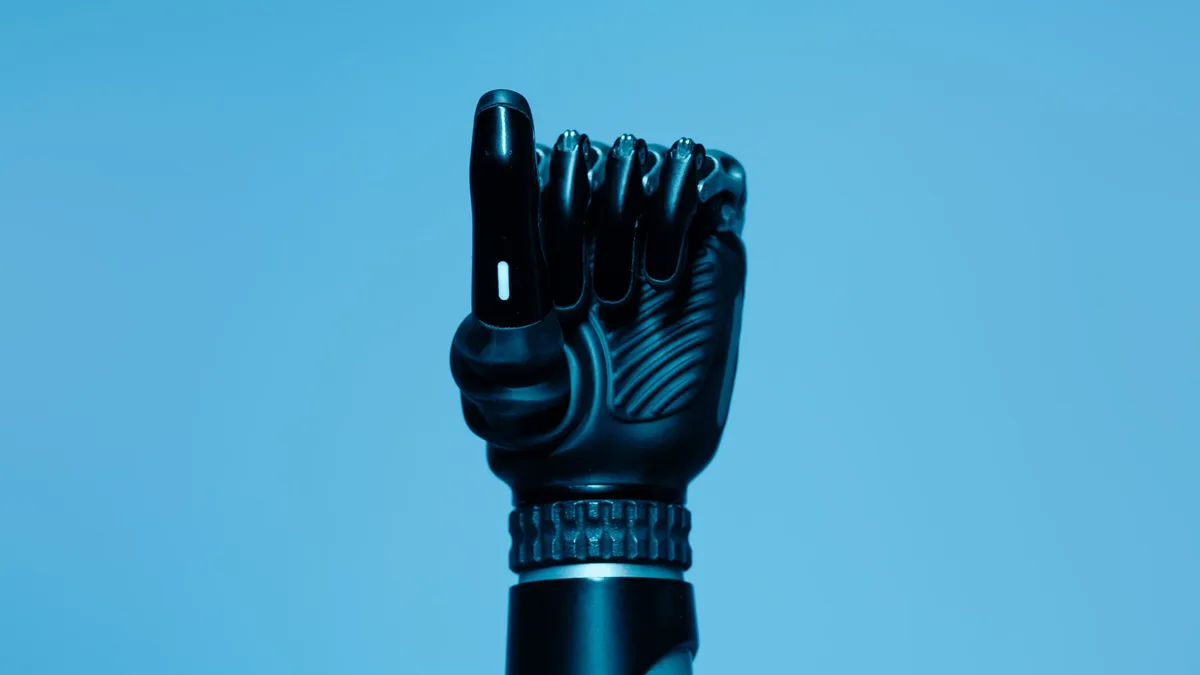
Boston Dynamics unveiled a redesigned hand for its Atlas humanoid robot featuring four fingers and 13 degrees of freedom. The new hand removes the pinky finger to improve size and functionality for mass manufacturing and direct actuation.
Designed for dexterous tool manipulation
The new hand shifts focus from general grasping to skilled manipulation. It enables precise pinch grasps between the thumb and any other finger. It is designed for triggered tool grasps, handling items like drills, power torque drivers, grinders, nail guns, and welding torches. With four fingers and 13 degrees of freedom, the hand enables in-hand reorientation, recovery from a slipping grasp, and handling tools while pressing triggers.
Built for real-world manufacturing use
Engineered for mass production, durability, and low-cost repair, the hand supports integration into Hyundai’s automotive manufacturing. Boston Dynamics opened its Robotics Metaplant Application Center (RMAC) at Hyundai Motor Group Metaplant America. The RMAC is a training center for integrating Atlas humanoids into Hyundai’s automotive manufacturing operations. The redesign was intended to reduce cost, size, and failure points. The new hand can be mass manufactured and repaired at reliably low cost.
Technical advances enable sim-to-real learning
The hand incorporates direct actuation and is built for high-fidelity simulation to enable sim-to-real reinforcement learning. All joints use a single actuator type. Actuators are completely encapsulated with no fragile cables crossing joints. The company maintained transparent direct actuation at the joints. The actuators are embedded directly into the joints in a direct drive configuration. The transmission allows motors to be back-driven and react to force and contact.
The hand has dense pressure tactile sensors covering fingertips and palm. These sensors detect small contact signals. Boston Dynamics believes reinforcement learning in simulation is essential for dexterous manipulation. The new hand can be cleanly simulated.
Human-inspired but not human-like
The hand is similar in size to a large human hand. It is close enough in form factor to a human hand that human demonstrations can be used to train it. Getting rid of the pinky was a straightforward decision after the team taped their pinkies to their ring fingers for a day. The new hand does not look cosmetically like a human hand.
The ability for fingers to splay open was added to allow one finger to move against another and to hold tool handles with triggers. Finger splay enables motions beyond what human hands are capable of. Reinforcement learning can be used to discover and exploit superhuman extra motions from finger splay.
Size was a big concern; the hand must grasp various objects and reach into small spaces. The size heavily drives the actuator design. Thanks to unique actuation technologies, the company maintained similar strength to the previous hand. Backdrivability and transparency of actuators are core to the robot’s design philosophy. The design allows reliance on proprioception for agile dexterous behaviors.
Previous versions of Atlas’s hand featured seven degrees of freedom and were designed to grasp a large variety of objects. The hand can slide the thumb fingertip along the length and across the width of all other fingers. Alberto Rodriguez is Director of Robot Behavior at Boston Dynamics. Dylan Thrush is a mechanical engineer on the Atlas team. Zachary Jackowski is Boston Dynamics’ chief product and technology officer.
Universal Manipulation Interfaces (UMIs) are wearables used for data collection in manipulation. They capture contact events and pressure distribution during natural task performance. Direct imitation has limits in whole body humanoid control. Whole body behavior is deployed on top of a whole body controller. The controller handles high rate dynamics like balancing, recovery steps, and force compensation. Whole body controllers are always trained with reinforcement learning in simulation. Human demonstrations capture visual complexities but not high-rate closed-loop control and force regulation.
Atlas demonstrated changing a drill bit with the new hands in a demo video.